GetJobzi vs Simplify
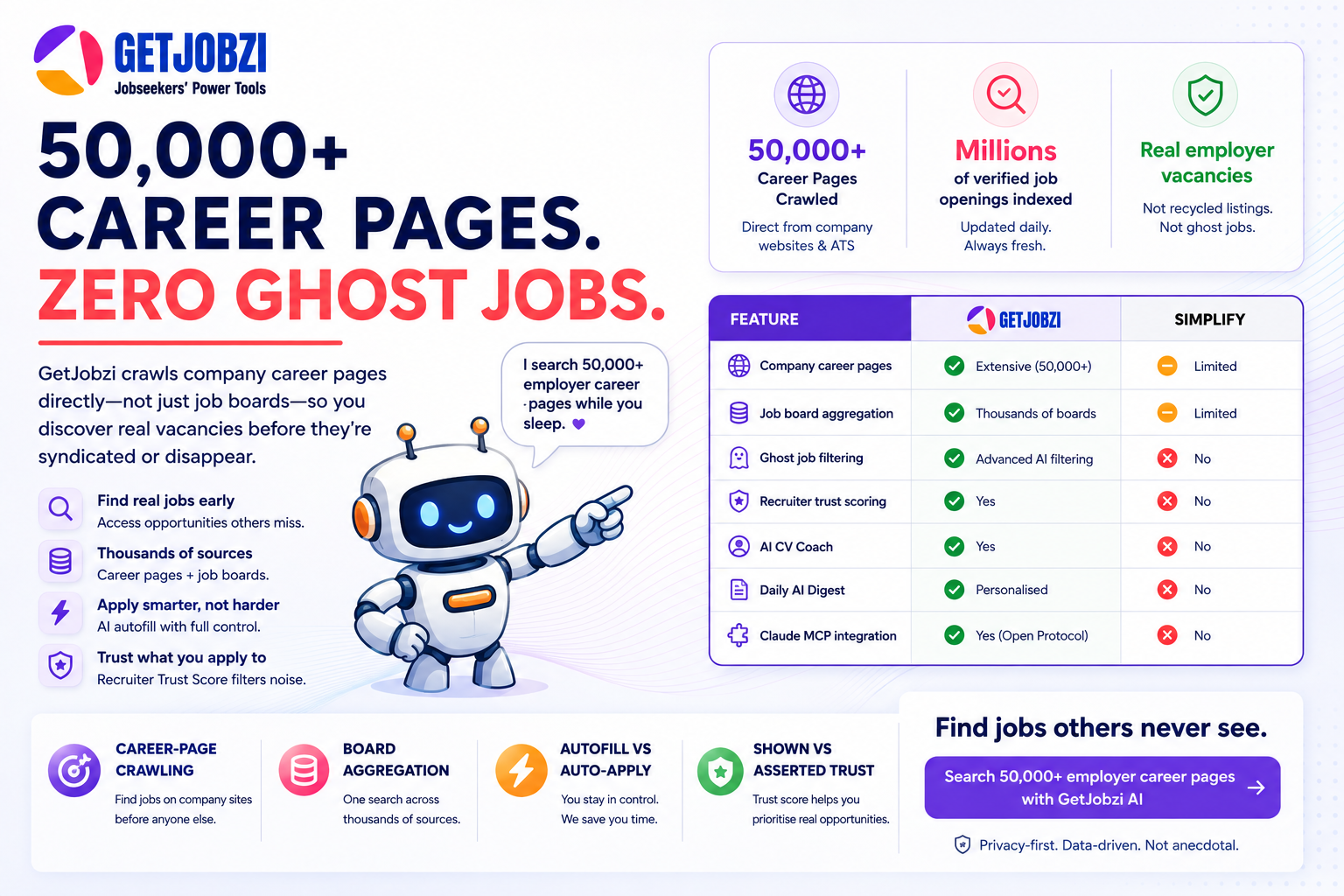
GetJobzi vs Simplify: Same Pitch, Completely Different Plumbing
They crawl 50,000 career pages. We aggregate the boards.
Where the two products look nearly identical
Profile in, matched jobs out, a tailored resume per role, one dashboard tracking every application instead of a spreadsheet. Both brand themselves as an AI agent rather than a job board. Both lean hard into the early-career and graduate segment, with name-brand employer logos as social proof. Both monetise the same way: free for jobseekers, employers pay to post or promote, a premium subscription layered on top. If you swapped the logos, a lot of the landing page copy would read the same.
The one difference that actually matters
Simplify doesn't aggregate third-party job boards. It checks the career pages of 50,000+ companies every hour, directly, plus a separate pool of roles employers submit exclusively to the platform. GetJobzi's model is board aggregation — pulling from Indeed, Reed, CV-Library, TotalJobs, LinkedIn, Adzuna and more.
That single architectural choice cascades into everything else. If you're crawling a company's own careers page, you mostly can't get an Adzuna-style syndication artifact — the same vacancy mirrored across dozens of tracking links within seconds — because there's only one source of truth per employer. Board aggregation doesn't have that luxury: it inherits every duplicate, every stale repost, every templated "trainee" role reposted from one location for months, because it's re-indexing other people's already-noisy indexes. Simplify's data-quality problem is structurally smaller by design. Ours is structurally larger by design — which is exactly why we've built the ghost-job detection, the duplicate-posting signal, and the advertiser trust scoring covered elsewhere on this blog.
🏢 Career-page crawling
Clean by construction for companies with their own careers page. Weaker on the long tail of SMEs and agencies that only ever post through a board or recruiter — no crawlable source to check.
📋 Board aggregation
Covers exactly that long tail — the SME and agency-posted roles with no career-page infrastructure of their own — at the cost of inheriting the boards' duplicate and quality problems wholesale.
Neither is simply better — they cover different parts of the market and inherit different problems. But it's a fair trade to name plainly rather than pretend our approach doesn't have a cost that theirs mostly avoids.
Autofill vs auto-apply
Simplify's Copilot extension autofills the repetitive fields on a job application and flags missing resume keywords — genuinely useful, and it's how they've gotten to 200M+ applications submitted. But the person still clicks submit, per application, on every site. GetJobzi's model applies automatically — up to 20 applications a day, submitted by the system within your criteria, each with a CV and cover letter optimised for that specific job description. That's a meaningfully deeper degree of automation, and also a bigger promise: submitting on someone's behalf carries more responsibility than helping them submit faster themselves.
What's genuinely worth taking from their approach
🤝 Networking Copilot
They productize finding the hiring manager and sending a personalised intro. We've told readers "nothing automates a warm introduction" — Simplify's take is that you can partially automate the groundwork toward one.
📑 Curated job lists
Human-curated collections ("Top Summer Internships," "Senior Roles at Unicorn Startups") layered on top of algorithmic matching — a natural extension of the data-driven content we're already building here.
🔀 Hybrid sourcing
Direct career-page crawling as a parallel source alongside board aggregation could shrink a real share of what our dedup and trust-scoring pipeline exists to clean up after the fact.
🎯 Where we can actually out-do them
Simplify's FAQ says companies are "vetted to ensure every job is legit and up to date" — with no visible methodology behind that claim. That's precisely the gap our trust-scoring work fills: showing the actual signals — posting patterns, salary disclosure, response data — behind a trust judgement, not just asserting one. A shown methodology beats an asserted one.
The honest scale check
1.5 million users, 200 million applications submitted, active communities on TikTok, Instagram and Reddit — Simplify is not a scrappy underdog in this category, it's a well-resourced incumbent. We wrote recently about what happened to Simply Hired: a pure aggregator with no differentiation lost to whoever could out-scale it on the identical model. The lesson generalises here too — a real architectural difference and a real trust-methodology advantage only stay advantages if we keep investing in them, not because we said so once.
See the difference between autofill and auto-apply
Start the free trial and let the system submit applications for you, not just fill them in faster.
👉 Start the free trial